Some of the links in today’s post are affiliate links. This means if you click on a link and purchase a book, I will receive an affiliate commission at no extra cost to you.
Love and belongingness are on Abraham Maslow’s famous needs pyramid, right after physiological survival and safety needs (Grison & Gazzaniga, 2022). Maslow’s work pre-dates evolutionary psychology: An evolutionary theorist would say it is a pre-condition of survival and a sense of safety and so should be at the very base of the pyramid (Cohen, 2023).
(Maslow is problematic: We may revisit him later. But even a stopped clock is right twice a day, so we do still teach the needs hierarchy — with reservations.)
When you don’t have these needs met, you are in a condition of “belonging uncertainty,” defined by Cohen and a research colleague as “the state of mind in which one suffers from doubts about whether one is fully accepted in a particular environment or ever could be (Cohen, 2023, p. 30).” This state of mind may be unconscious, conscious, or at lower levels of awareness.
When it’s triggered, regardless of whether we are consciously aware of it, “our horizon of possibility shrinks (Cohen, 2023, p. 30).” People will expect neither to understand nor to feel understood, and so will not take risks or to fully engage with whatever the group, institution, or organization is doing. People who chronically don’t feel like they belong become almost allergic to feedback because it feels like more of the same rejection. If they get feedback despite their best efforts to avoid it, they then have to defend against it to protect themselves from being made to feel even more “incapable (Cohen, 2023, p. 30)” than they already did.
As you may have gathered from the last couple of posts, I’m currently re-reading Cohen, G. L. (2023). Belonging – The science of creating connection and bridging divides. W.W. Norton. People who study it think we are in a “crisis of belonging,” and so Cohen, a Stanford researcher, professor, and consultant sets out in this book to teach us the science on belonging/belonging uncertainty and then show us what we can do to help ourselves and others mitigate belonging uncertainty and foster belonging.
Book bans have consequences
Remember how we talked earlier about people forming groups for both literal survival and psychological well-being? And then I made the claim that reading can also be a matter of literal physical survival and psychological well-being? I meant it. Books connect you to people you might never otherwise meet, and stories that you might not ever otherwise hear, and can teach you about your own life in a way that maybe nothing else could right at that point in time. They can give you a sense of belonging that might be lacking in your immediate environment and factual information that can make you happier, healthier, and it’s not an exaggeration to say that a book can even save your life.
Subtle slights accumulate over time
If a student doesn’t see books and other media available to them that reflect their identities back to them, by authors they can identify with and emulate, belongingness uncertainty can be gradually, subtly triggered. It’s a matter not necessarily of people saying racist, sexist, homophobic, or whatever things, but an ‘air of apartness (Cohen, 2023, p. 34)’ that the person feels. If the books were there when they matriculated and are later yanked, that is not subtle. It’s a clear message that issues at the core of their very being are not up for discussion — for example, for a sexual abuse survivor, the clear message coming from these school boards is that what she experienced is “obscene,” “pornographic”. These are the actual words used just last month here in my county’s school board meetings, in pronouncements made to the media afterward, and in subsequent vitriolic debates on Nextdoor and other local platforms when Toni Morrison’s The Bluest Eye was pulled from the shelves (Colley, 2026; Raby, 2026; Williams, 2026; ).
The Body Responds–and Not In a Good Way
We have potentially catastrophic physical responses to belonging uncertainty, similar to the phenomenon of weathering (Cohen, 2023):1
- brain regions associated with pain are more active
- genes that stimulate bodily inflammation get switched on “like fertilizer for early death (p. 32).”
- your heart rate, blood pressure, and stress hormone levels go up
- risk for cardiovascular illness and cancer increases
Marginalized groups are already primed for this, having already experienced years of exposure: One of Cohen’s (2023) studies revealed that Black college freshmen tend to interpret the same experiences that everyone else is having (for example, in adjusting to campus life) as being due to racism rather than to simply being newcomers to the community. This makes it all the more important that minoritized students or kids who are being victimized in some way be able to “see” themselves in their school libraries — in the authors, in the stories. Kids who cannot (yet) talk to each other or to a sympathetic adult about their concerns can pull a book off a shelf and scope it out in total privacy. A book can give them the words to talk to someone. No book? A student remains isolated.
But What Can Just One Person Do?
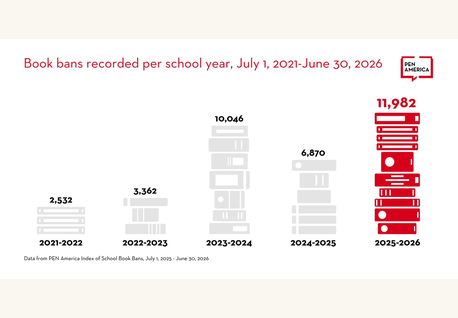
It seems overwhelming sometimes, doesn’t it? PEN recorded 11,982 book bans just in the last school year (Bekiempis, 2026). But we can act to stem the tide.
Pen America (“5 Ways to Fight Book Bans,” n.d.) gives five ways you can help keep the books that kids need to thrive on their library shelves (and this is not just for schools: Public libraries are coming under attack now, too) — you can…
- Attend board meetings and speak up!
- Write letters to the editors of local newspapers (many communities have more than one paper, and there may be dozens of possibilities in large metropolitan areas like Atlanta).
- Support authors, teachers, and librarians with a simple thank you note.
- Share like mad on social media (hashtag #FreeTheBooks).
- Be sure PEN America knows about bans in your community — you can report them here
What book(s) really hit you where you lived, when you were in school? What book literally saved your sanity or health or even your life when you were young? helped you solve a problem you thought was intractable, or might not have even realized was a problem before you encountered the book? What book gave you a new perspective on the world and your place in it? Please, tell us about it in the comments!
and be sure to subscribe so you can be notified of replies:
(If you enjoy these posts, you could buy me a coffee!)
If you ever see a book you want in one of these posts, you can buy it through my virtual bookstore, The Docsplainer Reads, simply by clicking on the link. A portion of the profits goes to the local independent, brick-and-mortar bookstore of your choice, and I get a few cents on the dollar, too — all at no extra cost to you. Some of the most-banned books are on sale through October 18th, 2026: You can see the list here (for adult readers–lists of banned YA and children’s titles are also available on the bookshop.org site). Use the discount code BBW26 for 15% off list price.
- “Weathering” is the term for the cumulative burden of prejudice, social alienation, institutional bias, economic exclusion, racial discrimination, and political oppression resulting in differences in health outcomes between races and other marginalized communities (“Weathering Hypothesis,” 2026). ↩︎
References
Bekiempis, V. (2026, October 5). US book bans in public schools reach record annual high of 12,000. The Guardian. https://www.theguardian.com/us-news/2026/oct/05/book-bans-schools-record-high
- Cohen’s listed on Stanford’s website as a Cornell grad who got his PhD at Stanford and teaches there now. He’s also taught at UC Boulder and Yale. Belonging is the main focus of his research in educational psychology, but he also teaches organizational psych and so applies his work to other forms of organization, consulting with, for example, Kaiser-Permanente, Merrill Lynch, a law firm, and a police academy. His 25-page resumé lists over 100 published scientific papers and many, many more presentations, talks, and invited addresses.
- I originally used the book as a text for building community in my online classes, where getting students to group up is a formidable challenge, but it is written for the lay public and I highly recommend it to anybody who’s ever in a position to help folks feel like they belong–and that’s virtually everyone except actual hermits!
Colley, F. (2026, October 5). Cobb County school board should admonish superintendent in book ban aftermath. AJC. Retrieved October 8, 2026, from https://www.ajc.com/opinion/2026/10/cobb-county-book-ban-toni-morrison-bluest-eye/
5 Ways to Fight Book Bans. (n.d.). PEN America. Retrieved October 8, 2026, from https://pen.org/book-bans/5-ways-to-fight-book-bans/
Grison, S., & Gazzaniga, M. S. (2022). Psychology in your life (4th ed.). W.W. Norton.
Raby, D. (2026, September 17). Toni Morrison’s “The Bluest Eye” removed from Cobb County school libraries. CBS Atlanta. https://www.cbsnews.com/atlanta/news/toni-morrisons-the-bluest-eye-removed-from-cobb-county-school-libraries/
Weathering hypothesis. (2026). Wikipedia. https://en.wikipedia.org/w/index.php?title=Weathering_hypothesis&oldid=1374676704
Williams, R. (2026, September 19). Georgia school system abruptly bans Toni Morrison’s ‘The Bluest Eye’. Georgia Recorder. https://georgiarecorder.com/2026/09/18/georgia-school-system-abruptly-bans-toni-morrisons-the-bluest-eye/
Wood, V. S. (2026, October 1). Belonging—or not—is a matter of life or death. The Docsplainer. https://docwood.wordpress.com/2026/10/01/belonging-or-not-is-a-matter-of-life-or-death/
Wood, V. S. (2026, October 5). Heck, reading is a matter of life and death! The Docsplainer. https://docwood.wordpress.com/2026/10/05/heck-reading-is-a-matter-of-life-and-death/



Leave a Reply