Some of the links in this post are affiliate links. This means if you click on the link and purchase the book, I will receive an affiliate commission at no extra cost to you.
Your Brain Is a Tiny Universe
Your brain is a tiny universe, having something like 86,000,000,000 neurons in it–as many stars as the universe contains (Weiten, 2017).1
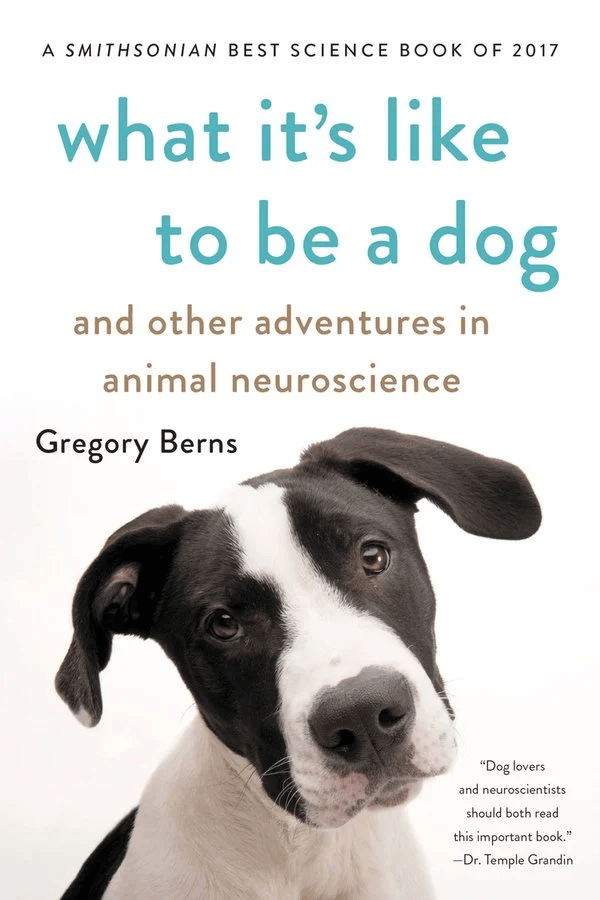
While the whole body is implicated in the psychology of everyday living (what we generally refer to as “mind”), the brain is the root of it all. Today, I’ll start to lay a foundation in the history and purpose of this marvelous organ you’ve got there. This post is based on one of my favorite lectures2, which in turn was based on Gregory Berns’s book, What it’s like to be a dog: And other adventures in animal neuroscience.
(Yes, I am a people shrink, but it is Berns’s theory–and I tend to agree–that we’re not all that different. I taught birds (mainly crows and owls), dogs, primates, and anything else relevant, just as psychologists have used other species in the lab to study learning, stress, perception, problem-solving, and so forth since the beginning.)
But I digress.
At bottom, every thought, every feeling, every idea, be it creative or criminal, every plan, every impulse, every physical response or act to what’s going on inside or around you, originates in the chemical and electrical processes occuring in the physical structure of the brain. So you have to understand the brain to understand your mind. And you have to understand your mind in order to make sense of everything else. We’ve always known this: Even the Buddha was teaching over 2400 years ago that
Mind precedes all mental states. Mind is their chief; they are all mind-wrought. If with an impure mind a person speaks or acts, suffering follows him like the wheel that follows the foot of the ox…. If with a pure mind a person speaks or acts, happiness follows him like his never-departing shadow (The Dhammapada, 1990, p. 3).
So this is nothing new. But over the last 100+ years, ancient wisdom and the philosophies that are the root of psychology have been rigorously lab-tested and it’s amazing to me how many things we’ve always known have proved out.
But again I am at risk of getting off track. Sorry about that. (I was constantly saying in class, “Now where was I??”)
So. Back to it. A brain is an expensive piece of machinery to maintain. Your brain is so key that even though it only makes up 2% of your body weight, it uses a full fifth of the blood flowing from your heart! By extrapolation, you then see that it’s using 20% of the oxygen that you breathe, too. As Berns puts it in the book, that makes it an expensive piece of machinery to maintain, and it’s also temperamental. Quick drops in blood pressure can result in immediate unconsciousness: in five minutes you sustain irreversible damage and in ten minutes you’re dead. In A Heat Dome Isn’t Business as Usual, I described how you can experience dangerous confusion, dizziness, disorientation, impulsivity, irritability, mood changes, judgment issues and even delirium before you’re even aware that you’re getting too hot.
Makes you think, doesn’t it? Something this fragile, this high-maintenance, must have a heck of an evolutionary advantage or, as a species, we wouldn’t put up with it.
So why do we have such a high-maintenance organ? To survive and reproduce? That seems obvious: It’s why everything evolves, in the end, right? Ok, then, but why do some animals have bigger brains? Why do animals with amazing survival and reproduction rates (think cockroaches) have the tiniest brains?
So Why Do We Have One?
Berns teaches (at Emory) that organisms first developed brains, quite simply, in order to do things.
The First Principle of Brains: Animals have brains so they can do things.
The first life forms developed 4 billion years ago. The first animals did not appear until more than 3 billion years later. They had nervous systems but no brains: What they had was nerve nets, kind of like jellyfish. They operated entirely on reflex. Think zombies.
Jellyfish are round. Once we flattened out into animals with left and right sides (bilaterians) we developed the first primitive central controllers. This was so important that every new animal that developed after that inherited the feature.
And once we had developed control of the body we had to have some means of deciding what to do. Go left? Go right? And so brains did not arise to process information which is the analogy you usually hear in courses like mine. They evolved to control the movement of creatures, to help them do things. This is Berns’ First Principle of Brains.
All animals with brains have muscles. All animals with muscles have brains.
This one-to-one correspondence–a perfect correlation3, by the way–suggests the following conclusion: to wit, animals have brains because they need to do things.
But why else do animals have brains? Remember that everything that happens in evolution happens because it makes the species better able to adapt, which means what? To survive long enough to reproduce successfully. Which leads to the next point.
The Second Principle of Brains: Animals have brains to tailor their actions to their environment.
We have established that animals have brains to do things. We know now that animals also have brains to tailor their actions to their environment. This is the Second Principle of Brains.
So fast forward another 100 million years or so and the first vertebrates appear (we’re now up to about 500 million years ago). They looked kind of like lampreys–think sand worms in Star Wars (and Dune before that), or the lowly hagfish. These had the first recognizable brains: There was an olfactory bulb, a primitive cortex, a sensory processing region, an area for coordination and regulation of life maintaining functions corresponding to our autonomic system.
No species of animal exists in isolation. The point of their brains is to link the external world to the animal’s decision-making systems and ultimately to their bodies. Go left, go right. One of the reasons I will keep telling you that psychology is not all between your ears!
But then what? Because there’s more to our brains than that, of course. So the question is starting to become, Why the modern brain?
Animals have got to do things. They have to tailor their actions to their immediate environments. But by now there are a number of species all competing for food sources and a safe space to reproduce, not to mention trying not to become a food source themselves! An animal that makes better choices than reflex, an animal whose behavior could be flexible to a point, has a better chance of survival and so.
The Third Principle of Brains: Animals have brains so they can learn.
All sentient beings, from Acadian Flycatchers to zebras, need to learn that their environment contains both good and bad outcomes–mostly the latter. Ok, you say, “But simply learning is backward-looking: There are no do-overs!” and you’re right. Survival and reproduction depend largely on making a long series of good choices while avoiding the bad ones that can kill you. There really are no do overs! And so we developed the capacity to plan.
(coming up soon, we’ll have an article about planning–and about flexibility)
The Fourth Principle of Brains: Animals have brains so they can simulate possible actions and future outcomes.
Brains simulate possible actions and future outcomes so as to make the best possible decision for the situation at hand. They’ve been doing this for us for 500 million years, since before fishes, certainly since before we even emerged onto land–before bones even.
Your brain is older than bones: Think about that! Is that cool, or what?
- according to the Brazilian (woman) scientist who first figured out a way to count them. ↩︎
- It’s hard to pick a favorite, because as I’ve said before, it’s a basic principle for me that if we’re not having fun learning new things, we’re not doing it right. So most of my lectures are my favorites! (You can use the link to watch, if you prefer that to reading.) ↩︎
- A perfect correlation means that if you see one of the pair, you will always see the other. That, in turn, means that if you see one, you can reliably predict 100% of the time that the other is also present. It does not imply any cause-and-effect relationship, however–just that the two always appear together. Brains don’t cause muscles, any more than a muscle could cause a brain. But you’ll never see one without the other, except in that one Star Trek episode…. ↩︎
(If you know which episode that was, for Pete’s sake please leave us a link in the Comments! I couldn’t find it and now it’s going to drive me crazy.)
And, as always, if any of this was helpful (or just interesting) to you in any way at all whatsoever, please buy me a coffee! I used to get paid for this work (not much, adjuncting being what it is, but still). Your kind donation keeps me in coffee and source material so that I can keep on keepin’ on.

You can buy any book mentioned in this post or appearing in my References list through my Bookshop,com storefront. That helps support not only the Docsplainer blog but also your brick-and-mortar bookstore of choice.
And thanks for stopping by to read today! I’m glad you’re here, for without readers, there can be no writers.

References
Berns, G. (2017). What it’s like to be a dog: And other adventures in animal neuroscience (1st ed.). Basic Books.
The Dhammapada: The Buddha’s Path of Wisdom (Acharya Buddharakkhita, Trans.). (1990). Buddhist Publication Society.
Weiten, W. (2017). Psychology: Themes and variations (10th ed.). Cengage Learning.


Leave a Reply