


So there is this cool exercise in our textbook (Grison & Gazzaniga, 2022) for students to do which, of course, I just had to try myself! I like never to ask them to do anything I haven’t tried, but this is a new(ish) book and I haven’t done everything yet.
I did this one, though, and it was fun…and informative. You’d think with four degrees in psych and years of therapy under my belt I’d know who I was, but no. Not entirely.
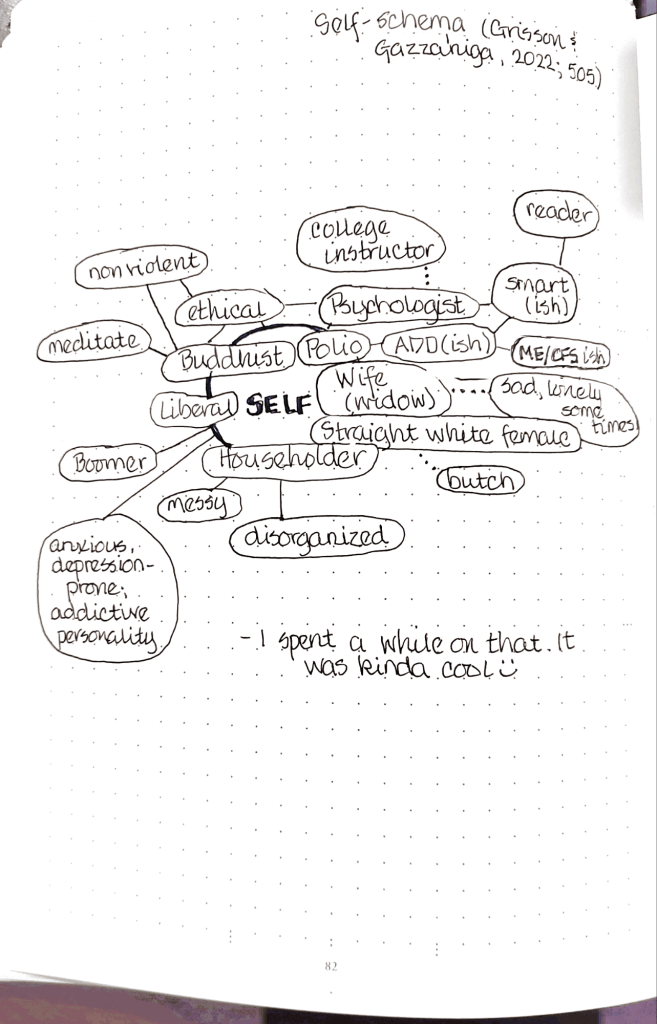
I mean, obviously, I knew these things. But there’s something about seeing it laid out in a schema like this that is…different. It’s not how I would have described myself off the top of my head in oh, say, speed-dating or a job interview.
Try it some time!
Grison and Gazzaniga suggest starting with a list of 10 ways that you could answer the question “Who am I?” (2022, p. 504). Then jot down how your thoughts, feelings, and behaviors flow from that. For example, one thing on my list was “protective,” and as a result I am quick to perceive a threat (thought), get my dander up (feeling), and move to defend those close to me (behavior)–or students, who I also consider my responsibility! You can get as specific as you want: Maybe I saw a threat where there was none, got mad, and yelled at somebody. Maybe I saw animal abuse/neglect, felt compassion, and rescued the critter. (Both have happened!)
Out of all our experiences, we develop schemas that are basically shorthand ways of understanding things. For example, you may have a schema of what a professor’s office looks like (desk, computer, diplomas, books) and therefore some preconceived notion of what mine might be like. Our schemas in turn affect what we pay attention to and what we remember: Sometimes, if a thing doesn’t fit our schema we don’t perceive it at all. If something belongs in our schema but in reality was not there, we may remember it as having been present. Or that thing that did not fit will be all we remember! You might come away from my office with no other memory than the very weird fact that there’s a guinea pig playpen in the middle of my floor, because that startling object occupied all your attention while you were here.
We have self-schemas that operate the same way. I used to have patients in my office on the daily who had grown up believing that they were not strong and who would complain that they couldn’t cope when, in fact, they were doing pretty well at dealing with whatever life had just handed them, all things considered. One woman in particular I recall saying “I cry all the time!” I replied, “Are you crying right now?” (She wasn’t.) “Were you crying when you got here?” (Nope.) “Can you remember a time that you didn’t cry yesterday?” And she was surprised to discover after a few minutes of this that she did not, indeed, cry “all the time” — or anything close to it. She cried a heck of a lot, and with good reason, but she was also coping–practicing self-care, making decisions, and taking actions to deal with what had happened.
Which is where the thing I drew in my BuJo comes in: How we see ourselves has everything to do with how we perceive and respond to the world around us. It’s built around your memories of your life, so what’s not foremost in your mind won’t find its way in there. For example, I used to be quite athletic (for a person with a disability, anyway) and yet “swimmer,” “equestrian,” and “hiker” are not in there. In a way, that makes sense, because those aren’t relevant any more. But I didn’t even think of them!
It also contains beliefs and generalizations (see schema, above) about you just like the ones you have about offices, and it functions in the same way. “Messy” and “disorganized” for me, for example, have a kind of self-perpetuating effect: Neat people would put away a thing when they’re done with it. I’m not neat, so I don’t.
Anyway. Try it for yourself! Draw the big “self” circle first, then moving out from the center, make a couple of progressively smaller circles beginning with the things that are the most important to your identity: Parent, maybe, if you are one and that’s central to who you are. Or female. These will overlap with “self” and may overlap with each other, depending (for example, female, daughter, and sister overlap). Lesser features will be smaller. Things that are in your life, like books and movies, might attach with a solid line, a dotted line, or not at all in descending order of importance. Like “butch” — because I wasn’t always and because it’s not something important or anything I make a conscious effort to do, either. It’s just something that sort of developed over decades and that I notice about myself now.
Have fun with it! And know that it is somewhat fluid. Depending on what developmental stage you are in or what happens to your health or in your life, it will change from year to year and sometimes quite suddenly. I woke up, for example, married one morning and was widowed by lunchtime. So revisit it in a year or so, or any time you have a big life change. It’s nicely grounding.
(By the way, because beliefs and generalizations are what schemas are made of, schemas figure pretty importantly in prejudices and discrimination–which we will talk more about in future.)
Reference
Grison, S., & Gazzaniga, M. S. (2022). Psychology in your life (Fourth edition). W.W. Norton & Company.


Leave a Reply